Given the array houses where houses[i] is the location of the ith house along a street and an integer k, allocate k mailboxes in the street.
Return the minimum total distance between each house and its nearest mailbox.
The test cases are generated so that the answer fits in a 32-bit integer.
Examples
Example 1
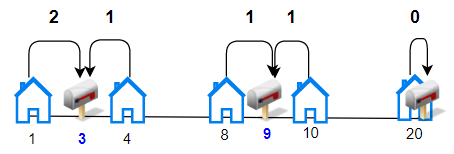
Input: houses = [1,4,8,10,20], k = 3
Output: 5
Explanation: Allocate mailboxes in position 3, 9 and 20.
Minimum total distance from each houses to nearest mailboxes is |3-1| + |4-3| + |9-8| + |10-9| + |20-20| = 5
Example 2
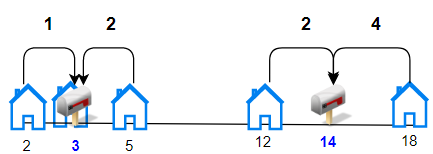
Input: houses = [2,3,5,12,18], k = 2
Output: 9
Explanation: Allocate mailboxes in position 3 and 14.
Minimum total distance from each houses to nearest mailboxes is |2-3| + |3-3| + |5-3| + |12-14| + |18-14| = 9.
Constraints
1 <= k <= houses.length <= 100
1 <= houses[i] <= 104
All the integers of houses are unique.
1478. Allocate Mailboxes
Hard
50 Points
Array
Math
Dynamic Programming
Sorting
Given the array houses where houses[i] is the location of the ith house along a street and an integer k, allocate k mailboxes in the street.
Return the minimum total distance between each house and its nearest mailbox.
The test cases are generated so that the answer fits in a 32-bit integer.
Examples
Example 1
Input: houses = [1,4,8,10,20], k = 3
Output: 5
Explanation: Allocate mailboxes in position 3, 9 and 20.
Minimum total distance from each houses to nearest mailboxes is |3-1| + |4-3| + |9-8| + |10-9| + |20-20| = 5
Example 2
Input: houses = [2,3,5,12,18], k = 2
Output: 9
Explanation: Allocate mailboxes in position 3 and 14.
Minimum total distance from each houses to nearest mailboxes is |2-3| + |3-3| + |5-3| + |12-14| + |18-14| = 9.