Construct String from Binary Tree - Practice Coding | SlaveCode
0
0123456789
0
0123456789
:
0
0123456789
0
0123456789
606. Construct String from Binary Tree
Medium
30 Points
String
Tree
Depth-First Search
Binary Tree
Given the root node of a binary tree, your task is to create a string representation of the tree following a specific set of formatting rules. The representation should be based on a preorder traversal of the binary tree and must adhere to the following guidelines:
Examples
Example 1
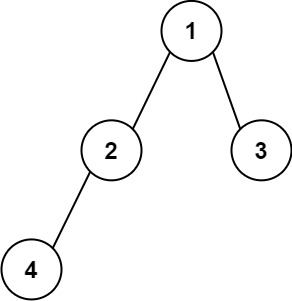
Input: root = [1,2,3,4]
Output: "1(2(4))(3)"
Explanation: Originally, it needs to be "1(2(4)())(3()())", but you need to omit all the empty parenthesis pairs. And it will be "1(2(4))(3)".
Example 2
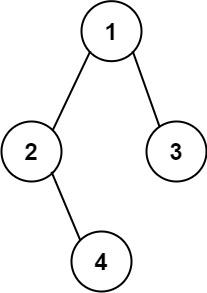
Input: root = [1,2,3,null,4]
Output: "1(2()(4))(3)"
Explanation: Almost the same as the first example, except the () after 2 is necessary to indicate the absence of a left child for 2 and the presence of a right child.
Constraints
The number of nodes in the tree is in the range [1, 104].
-1000 <= Node.val <= 1000
606. Construct String from Binary Tree
Medium
30 Points
String
Tree
Depth-First Search
Binary Tree
Given the root node of a binary tree, your task is to create a string representation of the tree following a specific set of formatting rules. The representation should be based on a preorder traversal of the binary tree and must adhere to the following guidelines:
Examples
Example 1
Input: root = [1,2,3,4]
Output: "1(2(4))(3)"
Explanation: Originally, it needs to be "1(2(4)())(3()())", but you need to omit all the empty parenthesis pairs. And it will be "1(2(4))(3)".
Example 2
Input: root = [1,2,3,null,4]
Output: "1(2()(4))(3)"
Explanation: Almost the same as the first example, except the () after 2 is necessary to indicate the absence of a left child for 2 and the presence of a right child.
Constraints
The number of nodes in the tree is in the range [1, 104].