Find the Maximum Number of Fruits Collected - Practice Coding | SlaveCode
0
0123456789
0
0123456789
:
0
0123456789
0
0123456789
3363. Find the Maximum Number of Fruits Collected
Hard
50 Points
Array
Dynamic Programming
Matrix
There is a game dungeon comprised of n x n rooms arranged in a grid.
You are given a 2D array fruits of size n x n, where fruits[i][j] represents the number of fruits in the room (i, j). Three children will play in the game dungeon, with initial positions at the corner rooms (0, 0), (0, n - 1), and (n - 1, 0).
The children will make exactly n - 1 moves according to the following rules to reach the room (n - 1, n - 1):
When a child enters a room, they will collect all the fruits there. If two or more children enter the same room, only one child will collect the fruits, and the room will be emptied after they leave.
Return the maximum number of fruits the children can collect from the dungeon.
Examples
Example 1
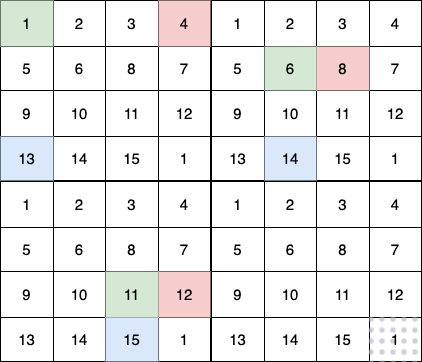
Input: fruits = [[1,2,3,4],[5,6,8,7],[9,10,11,12],[13,14,15,16]]
Output: 100
Explanation:
In this example:
In total they collect 1 + 6 + 11 + 16 + 4 + 8 + 12 + 13 + 14 + 15 = 100 fruits.
Example 2
Input: fruits = [[1,1],[1,1]]
Output: 4
Explanation:
In this example:
In total they collect 1 + 1 + 1 + 1 = 4 fruits.
Constraints
2 <= n == fruits.length == fruits[i].length <= 1000
0 <= fruits[i][j] <= 1000
3363. Find the Maximum Number of Fruits Collected
Hard
50 Points
Array
Dynamic Programming
Matrix
There is a game dungeon comprised of n x n rooms arranged in a grid.
You are given a 2D array fruits of size n x n, where fruits[i][j] represents the number of fruits in the room (i, j). Three children will play in the game dungeon, with initial positions at the corner rooms (0, 0), (0, n - 1), and (n - 1, 0).
The children will make exactly n - 1 moves according to the following rules to reach the room (n - 1, n - 1):
When a child enters a room, they will collect all the fruits there. If two or more children enter the same room, only one child will collect the fruits, and the room will be emptied after they leave.
Return the maximum number of fruits the children can collect from the dungeon.
Examples
Example 1
Input: fruits = [[1,2,3,4],[5,6,8,7],[9,10,11,12],[13,14,15,16]]
Output: 100
Explanation:
In this example:
In total they collect 1 + 6 + 11 + 16 + 4 + 8 + 12 + 13 + 14 + 15 = 100 fruits.
Example 2
Input: fruits = [[1,1],[1,1]]
Output: 4
Explanation:
In this example:
In total they collect 1 + 1 + 1 + 1 = 4 fruits.
Constraints
2 <= n == fruits.length == fruits[i].length <= 1000