Flip Equivalent Binary Trees - Practice Coding | SlaveCode
0
0123456789
0
0123456789
:
0
0123456789
0
0123456789
951. Flip Equivalent Binary Trees
Medium
30 Points
Tree
Depth-First Search
Binary Tree
For a binary tree T, we can define a flip operation as follows: choose any node, and swap the left and right child subtrees.
A binary tree X is flip equivalent to a binary tree Y if and only if we can make X equal to Y after some number of flip operations.
Given the roots of two binary trees root1 and root2, return true if the two trees are flip equivalent or false otherwise.
Examples
Example 1
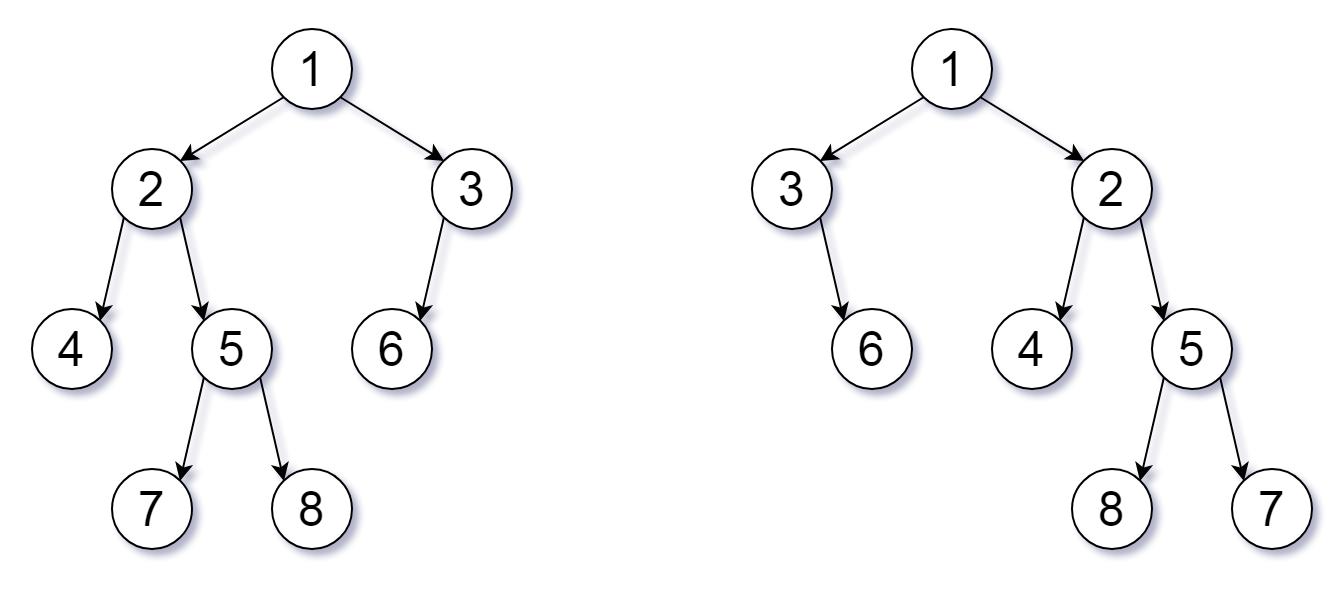
Input: root1 = [1,2,3,4,5,6,null,null,null,7,8], root2 = [1,3,2,null,6,4,5,null,null,null,null,8,7]
Output: true
Explanation: We flipped at nodes with values 1, 3, and 5.
Example 2
Input: root1 = [], root2 = []
Output: true
Example 3
Input: root1 = [], root2 = [1]
Output: false
Constraints
The number of nodes in each tree is in the range [0, 100].
Each tree will have unique node values in the range [0, 99].
951. Flip Equivalent Binary Trees
Medium
30 Points
Tree
Depth-First Search
Binary Tree
For a binary tree T, we can define a flip operation as follows: choose any node, and swap the left and right child subtrees.
A binary tree X is flip equivalent to a binary tree Y if and only if we can make X equal to Y after some number of flip operations.
Given the roots of two binary trees root1 and root2, return true if the two trees are flip equivalent or false otherwise.
Examples
Example 1
Input: root1 = [1,2,3,4,5,6,null,null,null,7,8], root2 = [1,3,2,null,6,4,5,null,null,null,null,8,7]
Output: true
Explanation: We flipped at nodes with values 1, 3, and 5.
Example 2
Input: root1 = [], root2 = []
Output: true
Example 3
Input: root1 = [], root2 = [1]
Output: false
Constraints
The number of nodes in each tree is in the range [0, 100].
Each tree will have unique node values in the range [0, 99].