Minimum Increments to Equalize Leaf Paths - Practice Coding | SlaveCode
0
0123456789
0
0123456789
:
0
0123456789
0
0123456789
3593. Minimum Increments to Equalize Leaf Paths
Medium
30 Points
Array
Dynamic Programming
Tree
Depth-First Search
You are given an integer n and an undirected tree rooted at node 0 with n nodes numbered from 0 to n - 1. This is represented by a 2D array edges of length n - 1, where edges[i] = [ui, vi] indicates an edge from node ui to vi .
Each node i has an associated cost given by cost[i], representing the cost to traverse that node.
The score of a path is defined as the sum of the costs of all nodes along the path.
Your goal is to make the scores of all root-to-leaf paths equal by increasing the cost of any number of nodes by any non-negative amount.
Return the minimum number of nodes whose cost must be increased to make all root-to-leaf path scores equal.
Examples
Example 1
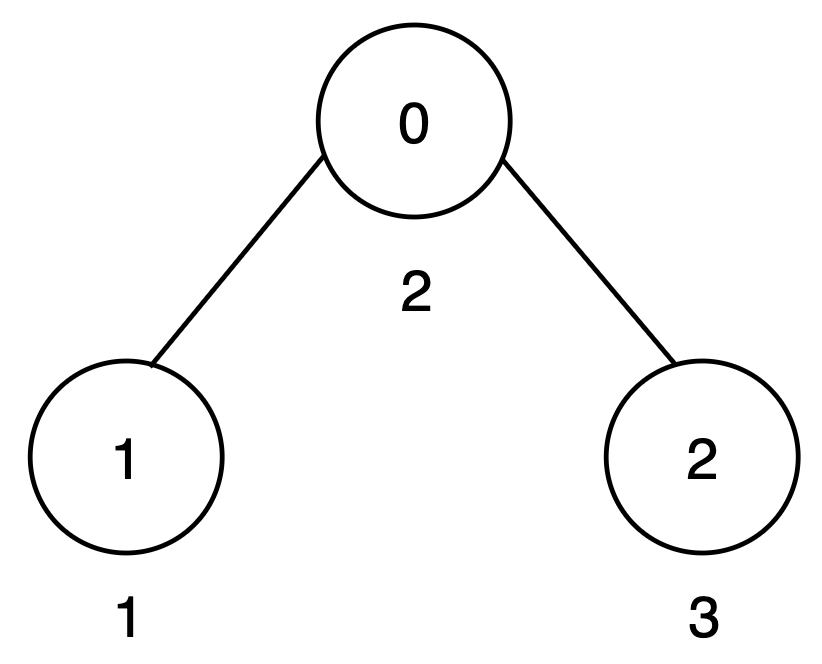
Input: n = 3, edges = [[0,1],[0,2]], cost = [2,1,3]
Output: 1
Explanation:
There are two root-to-leaf paths:
To make all root-to-leaf path scores equal to 5, increase the cost of node 1 by 2. Only one node is increased, so the output is 1.
Example 2
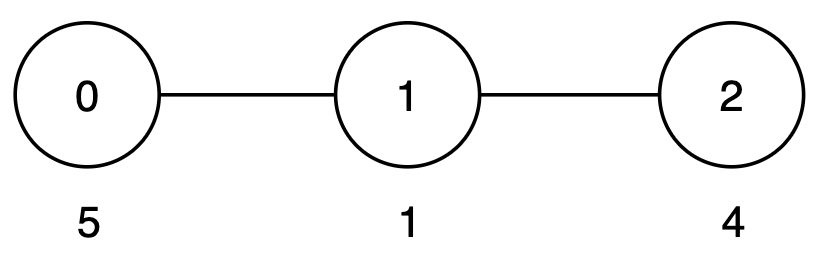
Input: n = 3, edges = [[0,1],[1,2]], cost = [5,1,4]
Output: 0
Explanation:
There is only one root-to-leaf path:
Path 0 → 1 → 2 has a score of 5 + 1 + 4 = 10 .
Since only one root-to-leaf path exists, all path costs are trivially equal, and the output is 0.
Example 3
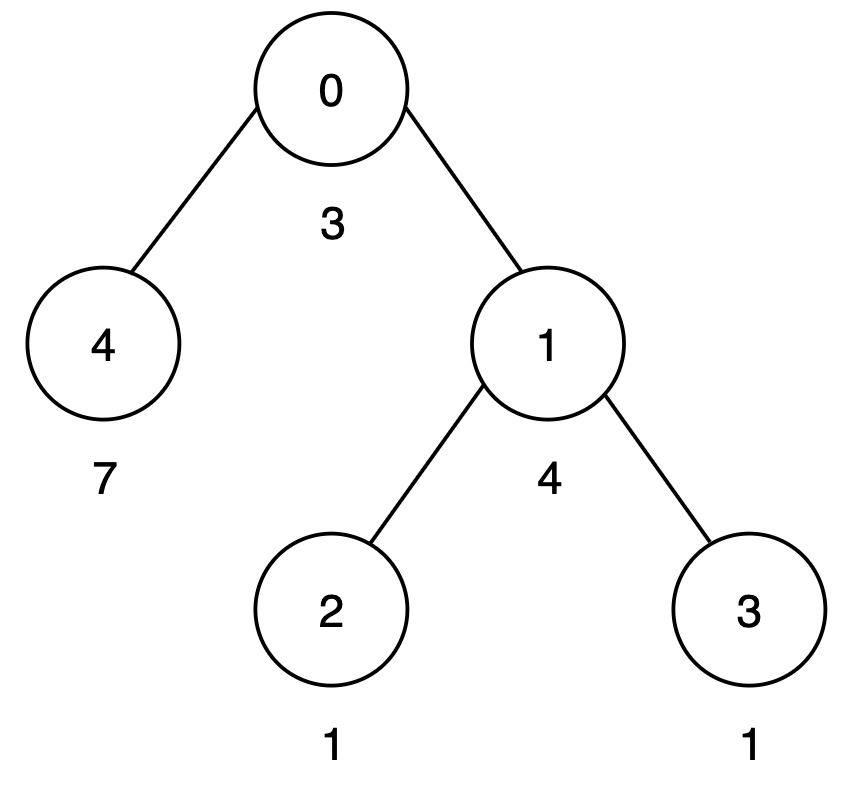
Input: n = 5, edges = [[0,4],[0,1],[1,2],[1,3]], cost = [3,4,1,1,7]
Output: 1
Explanation:
There are three root-to-leaf paths:
To make all root-to-leaf path scores equal to 10, increase the cost of node 1 by 2. Thus, the output is 1.
Constraints
2 <= n <= 105
edges.length == n - 1
edges[i] == [ui, vi]
0 <= ui, vi < n
cost.length == n
1 <= cost[i] <= 109
The input is generated such that edges represents a valid tree.
3593. Minimum Increments to Equalize Leaf Paths
Medium
30 Points
Array
Dynamic Programming
Tree
Depth-First Search
You are given an integer n and an undirected tree rooted at node 0 with n nodes numbered from 0 to n - 1. This is represented by a 2D array edges of length n - 1, where edges[i] = [ui, vi] indicates an edge from node ui to vi .
Each node i has an associated cost given by cost[i], representing the cost to traverse that node.
The score of a path is defined as the sum of the costs of all nodes along the path.
Your goal is to make the scores of all root-to-leaf paths equal by increasing the cost of any number of nodes by any non-negative amount.
Return the minimum number of nodes whose cost must be increased to make all root-to-leaf path scores equal.
Examples
Example 1
Input: n = 3, edges = [[0,1],[0,2]], cost = [2,1,3]
Output: 1
Explanation:
There are two root-to-leaf paths:
To make all root-to-leaf path scores equal to 5, increase the cost of node 1 by 2. Only one node is increased, so the output is 1.
Example 2
Input: n = 3, edges = [[0,1],[1,2]], cost = [5,1,4]
Output: 0
Explanation:
There is only one root-to-leaf path:
Path 0 → 1 → 2 has a score of 5 + 1 + 4 = 10 .
Since only one root-to-leaf path exists, all path costs are trivially equal, and the output is 0.
Example 3
Input: n = 5, edges = [[0,4],[0,1],[1,2],[1,3]], cost = [3,4,1,1,7]
Output: 1
Explanation:
There are three root-to-leaf paths:
To make all root-to-leaf path scores equal to 10, increase the cost of node 1 by 2. Thus, the output is 1.
Constraints
2 <= n <= 105
edges.length == n - 1
edges[i] == [ui, vi]
0 <= ui, vi < n
cost.length == n
1 <= cost[i] <= 109
The input is generated such that edges represents a valid tree.