Given a 0-indexed m x n integer matrix matrix, create a new 0-indexed matrix called answer. Make answer equal to matrix, then replace each element with the value -1 with the maximum element in its respective column.
Return the matrix answer.
Examples
Example 1
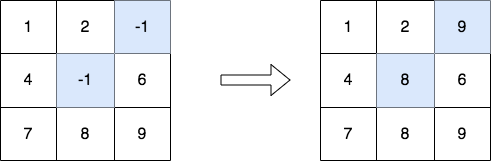
Input: matrix = [[1,2,-1],[4,-1,6],[7,8,9]]
Output: [[1,2,9],[4,8,6],[7,8,9]]
Explanation: The diagram above shows the elements that are changed (in blue).
- We replace the value in the cell [1][1] with the maximum value in the column 1, that is 8.
- We replace the value in the cell [0][2] with the maximum value in the column 2, that is 9.
Example 2
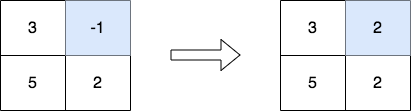
Input: matrix = [[3,-1],[5,2]]
Output: [[3,2],[5,2]]
Explanation: The diagram above shows the elements that are changed (in blue).
Constraints
m == matrix.length
n == matrix[i].length
2 <= m, n <= 50
-1 <= matrix[i][j] <= 100
The input is generated such that each column contains at least one non-negative integer.
3033. Modify the Matrix
Easy
10 Points
Array
Matrix
Given a 0-indexed m x n integer matrix matrix, create a new 0-indexed matrix called answer. Make answer equal to matrix, then replace each element with the value -1 with the maximum element in its respective column.
Return the matrix answer.
Examples
Example 1
Input: matrix = [[1,2,-1],[4,-1,6],[7,8,9]]
Output: [[1,2,9],[4,8,6],[7,8,9]]
Explanation: The diagram above shows the elements that are changed (in blue).
- We replace the value in the cell [1][1] with the maximum value in the column 1, that is 8.
- We replace the value in the cell [0][2] with the maximum value in the column 2, that is 9.
Example 2
Input: matrix = [[3,-1],[5,2]]
Output: [[3,2],[5,2]]
Explanation: The diagram above shows the elements that are changed (in blue).
Constraints
m == matrix.length
n == matrix[i].length
2 <= m, n <= 50
-1 <= matrix[i][j] <= 100
The input is generated such that each column contains at least one non-negative integer.