Number of Black Blocks - Practice Coding | SlaveCode
0
0123456789
0
0123456789
:
0
0123456789
0
0123456789
2768. Number of Black Blocks
Medium
30 Points
Array
Hash Table
Enumeration
You are given two integers m and n representing the dimensions of a 0-indexed m x n grid.
You are also given a 0-indexed 2D integer matrix coordinates, where coordinates[i] = [x, y] indicates that the cell with coordinates [x, y] is colored black. All cells in the grid that do not appear in coordinates are white.
A block is defined as a 2 x 2 submatrix of the grid. More formally, a block with cell [x, y] as its top-left corner where 0 <= x < m - 1 and 0 <= y < n - 1 contains the coordinates [x, y], [x + 1, y], [x, y + 1], and [x + 1, y + 1].
Return a 0-indexed integer array arr of size 5 such that arr[i] is the number of blocks that contains exactly i black cells.
Examples
Example 1
Input: m = 3, n = 3, coordinates = [[0,0]]
Output: [3,1,0,0,0]
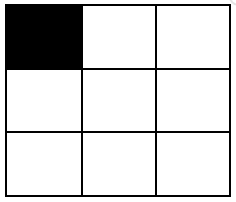
Explanation: The grid looks like this:
There is only 1 block with one black cell, and it is the block starting with cell [0,0].
The other 3 blocks start with cells [0,1], [1,0] and [1,1]. They all have zero black cells.
Thus, we return [3,1,0,0,0].
Example 2
Input: m = 3, n = 3, coordinates = [[0,0],[1,1],[0,2]]
Output: [0,2,2,0,0]
Explanation: The grid looks like this:
There are 2 blocks with two black cells (the ones starting with cell coordinates [0,0] and [0,1]).
The other 2 blocks have starting cell coordinates of [1,0] and [1,1]. They both have 1 black cell.
Therefore, we return [0,2,2,0,0].
Constraints
2 <= m <= 105
2 <= n <= 105
0 <= coordinates.length <= 104
coordinates[i].length == 2
0 <= coordinates[i][0] < m
0 <= coordinates[i][1] < n
It is guaranteed that coordinates contains pairwise distinct coordinates.
2768. Number of Black Blocks
Medium
30 Points
Array
Hash Table
Enumeration
You are given two integers m and n representing the dimensions of a 0-indexed m x n grid.
You are also given a 0-indexed 2D integer matrix coordinates, where coordinates[i] = [x, y] indicates that the cell with coordinates [x, y] is colored black. All cells in the grid that do not appear in coordinates are white.
A block is defined as a 2 x 2 submatrix of the grid. More formally, a block with cell [x, y] as its top-left corner where 0 <= x < m - 1 and 0 <= y < n - 1 contains the coordinates [x, y], [x + 1, y], [x, y + 1], and [x + 1, y + 1].
Return a 0-indexed integer array arr of size 5 such that arr[i] is the number of blocks that contains exactly i black cells.
Examples
Example 1
Input: m = 3, n = 3, coordinates = [[0,0]]
Output: [3,1,0,0,0]
Explanation: The grid looks like this:
There is only 1 block with one black cell, and it is the block starting with cell [0,0].
The other 3 blocks start with cells [0,1], [1,0] and [1,1]. They all have zero black cells.
Thus, we return [3,1,0,0,0].
Example 2
Input: m = 3, n = 3, coordinates = [[0,0],[1,1],[0,2]]
Output: [0,2,2,0,0]
Explanation: The grid looks like this:
There are 2 blocks with two black cells (the ones starting with cell coordinates [0,0] and [0,1]).
The other 2 blocks have starting cell coordinates of [1,0] and [1,1]. They both have 1 black cell.
Therefore, we return [0,2,2,0,0].
Constraints
2 <= m <= 105
2 <= n <= 105
0 <= coordinates.length <= 104
coordinates[i].length == 2
0 <= coordinates[i][0] < m
0 <= coordinates[i][1] < n
It is guaranteed that coordinates contains pairwise distinct coordinates.