Number of Different Subsequences GCDs - Practice Coding | SlaveCode
0
0123456789
0
0123456789
:
0
0123456789
0
0123456789
1819. Number of Different Subsequences GCDs
Hard
50 Points
Array
Math
Counting
Number Theory
You are given an array nums that consists of positive integers.
The GCD of a sequence of numbers is defined as the greatest integer that divides all the numbers in the sequence evenly.
A subsequence of an array is a sequence that can be formed by removing some elements (possibly none) of the array.
Return the number of different GCDs among all non-empty subsequences of nums.
Examples
Example 1
Input: nums = [6,10,3]
Output: 5
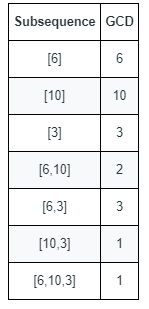
Explanation: The figure shows all the non-empty subsequences and their GCDs.
The different GCDs are 6, 10, 3, 2, and 1.
Example 2
Input: nums = [5,15,40,5,6]
Output: 7
Constraints
1 <= nums.length <= 105
1 <= nums[i] <= 2 * 105
1819. Number of Different Subsequences GCDs
Hard
50 Points
Array
Math
Counting
Number Theory
You are given an array nums that consists of positive integers.
The GCD of a sequence of numbers is defined as the greatest integer that divides all the numbers in the sequence evenly.
A subsequence of an array is a sequence that can be formed by removing some elements (possibly none) of the array.
Return the number of different GCDs among all non-empty subsequences of nums.
Examples
Example 1
Input: nums = [6,10,3]
Output: 5
Explanation: The figure shows all the non-empty subsequences and their GCDs.
The different GCDs are 6, 10, 3, 2, and 1.