Populating Next Right Pointers in Each Node II - Practice Coding | SlaveCode
0
0123456789
0
0123456789
:
0
0123456789
0
0123456789
117. Populating Next Right Pointers in Each Node II
Medium
30 Points
Linked List
Tree
Depth-First Search
Breadth-First Search
Binary Tree
Given a binary tree
Populate each next pointer to point to its next right node. If there is no next right node, the next pointer should be set to NULL.
Initially, all next pointers are set to NULL.
Input: root = [1,2,3,4,5,null,7]
Output: [1,#,2,3,#,4,5,7,#]
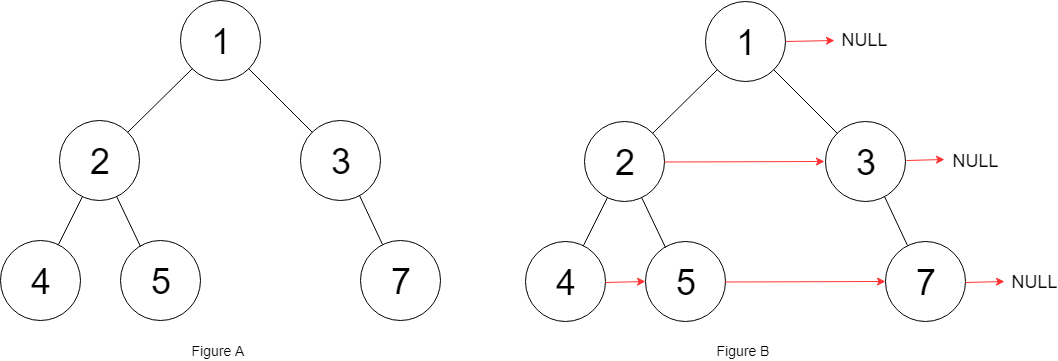
Explanation: Given the above binary tree (Figure A), your function should populate each next pointer to point to its next right node, just like in Figure B. The serialized output is in level order as connected by the next pointers, with '#' signifying the end of each level.
Example 3
Input: root = []
Output: []
Constraints
The number of nodes in the tree is in the range [0, 6000].
-100 <= Node.val <= 100
117. Populating Next Right Pointers in Each Node II
Medium
30 Points
Linked List
Tree
Depth-First Search
Breadth-First Search
Binary Tree
Given a binary tree
Populate each next pointer to point to its next right node. If there is no next right node, the next pointer should be set to NULL.
Initially, all next pointers are set to NULL.
Input: root = [1,2,3,4,5,null,7]
Output: [1,#,2,3,#,4,5,7,#]
Explanation: Given the above binary tree (Figure A), your function should populate each next pointer to point to its next right node, just like in Figure B. The serialized output is in level order as connected by the next pointers, with '#' signifying the end of each level.
Example 3
Input: root = []
Output: []
Constraints
The number of nodes in the tree is in the range [0, 6000].