You are given a 0-indexed two-dimensional integer array nums.
Return the largest prime number that lies on at least one of the diagonals of nums. In case, no prime is present on any of the diagonals, return 0.
Note that:
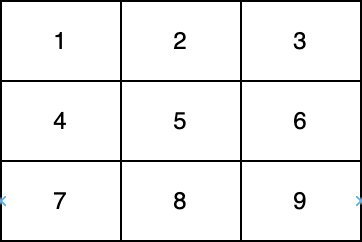
In the above diagram, one diagonal is [1,5,9] and another diagonal is [3,5,7].
Examples
Example 1
Input: nums = [[1,2,3],[5,6,7],[9,10,11]]
Output: 11
Explanation: The numbers 1, 3, 6, 9, and 11 are the only numbers present on at least one of the diagonals. Since 11 is the largest prime, we return 11.
Example 2
Input: nums = [[1,2,3],[5,17,7],[9,11,10]]
Output: 17
Explanation: The numbers 1, 3, 9, 10, and 17 are all present on at least one of the diagonals. 17 is the largest prime, so we return 17.
Constraints
1 <= nums.length <= 300
nums.length == numsi.length
1 <= nums[i][j] <= 4*106
2614. Prime In Diagonal
Easy
10 Points
Array
Math
Matrix
Number Theory
You are given a 0-indexed two-dimensional integer array nums.
Return the largest prime number that lies on at least one of the diagonals of nums. In case, no prime is present on any of the diagonals, return 0.
Note that:
In the above diagram, one diagonal is [1,5,9] and another diagonal is [3,5,7].
Examples
Example 1
Input: nums = [[1,2,3],[5,6,7],[9,10,11]]
Output: 11
Explanation: The numbers 1, 3, 6, 9, and 11 are the only numbers present on at least one of the diagonals. Since 11 is the largest prime, we return 11.
Example 2
Input: nums = [[1,2,3],[5,17,7],[9,11,10]]
Output: 17
Explanation: The numbers 1, 3, 9, 10, and 17 are all present on at least one of the diagonals. 17 is the largest prime, so we return 17.