There are n rings and each ring is either red, green, or blue. The rings are distributed across ten rods labeled from 0 to 9.
You are given a string rings of length 2n that describes the n rings that are placed onto the rods. Every two characters in rings forms a color-position pair that is used to describe each ring where:
For example, "R3G2B1" describes n == 3 rings: a red ring placed onto the rod labeled 3, a green ring placed onto the rod labeled 2, and a blue ring placed onto the rod labeled 1.
Return the number of rods that have all three colors of rings on them.
Examples
Example 1
Input: rings = "B0B6G0R6R0R6G9"
Output: 1
Explanation:
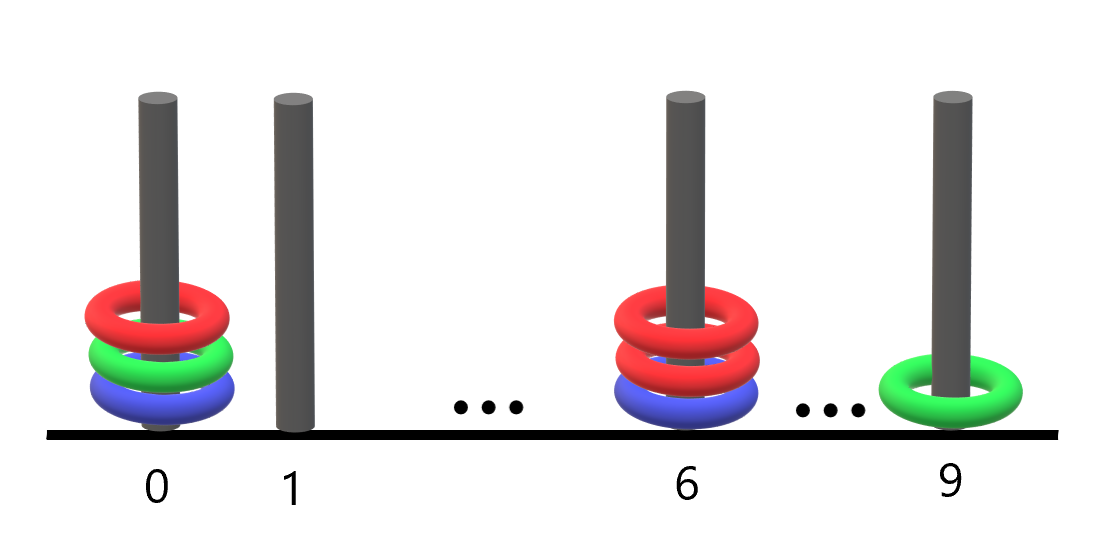
- The rod labeled 0 holds 3 rings with all colors: red, green, and blue.
- The rod labeled 6 holds 3 rings, but it only has red and blue.
- The rod labeled 9 holds only a green ring.
Thus, the number of rods with all three colors is 1.
Example 2
Input: rings = "B0R0G0R9R0B0G0"
Output: 1
Explanation:
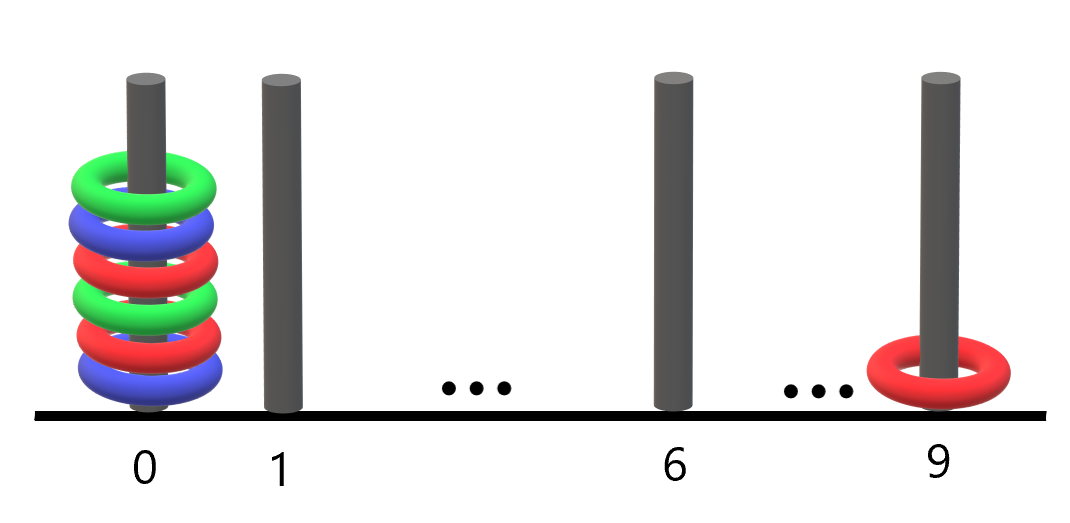
- The rod labeled 0 holds 6 rings with all colors: red, green, and blue.
- The rod labeled 9 holds only a red ring.
Thus, the number of rods with all three colors is 1.
Example 3
Input: rings = "G4"
Output: 0
Explanation:
Only one ring is given. Thus, no rods have all three colors.
Constraints
rings.length == 2 * n
1 <= n <= 100
rings[i] where i is even is either 'R', 'G', or 'B' (0-indexed).
rings[i] where i is odd is a digit from '0' to '9' (0-indexed).
2103. Rings and Rods
Easy
10 Points
Hash Table
String
There are n rings and each ring is either red, green, or blue. The rings are distributed across ten rods labeled from 0 to 9.
You are given a string rings of length 2n that describes the n rings that are placed onto the rods. Every two characters in rings forms a color-position pair that is used to describe each ring where:
For example, "R3G2B1" describes n == 3 rings: a red ring placed onto the rod labeled 3, a green ring placed onto the rod labeled 2, and a blue ring placed onto the rod labeled 1.
Return the number of rods that have all three colors of rings on them.
Examples
Example 1
Input: rings = "B0B6G0R6R0R6G9"
Output: 1
Explanation:
- The rod labeled 0 holds 3 rings with all colors: red, green, and blue.
- The rod labeled 6 holds 3 rings, but it only has red and blue.
- The rod labeled 9 holds only a green ring.
Thus, the number of rods with all three colors is 1.
Example 2
Input: rings = "B0R0G0R9R0B0G0"
Output: 1
Explanation:
- The rod labeled 0 holds 6 rings with all colors: red, green, and blue.
- The rod labeled 9 holds only a red ring.
Thus, the number of rods with all three colors is 1.
Example 3
Input: rings = "G4"
Output: 0
Explanation:
Only one ring is given. Thus, no rods have all three colors.
Constraints
rings.length == 2 * n
1 <= n <= 100
rings[i] where i is even is either 'R', 'G', or 'B' (0-indexed).
rings[i] where i is odd is a digit from '0' to '9' (0-indexed).