Sort Matrix by Diagonals - Practice Coding | SlaveCode
0
0123456789
0
0123456789
:
0
0123456789
0
0123456789
3446. Sort Matrix by Diagonals
Medium
30 Points
Array
Sorting
Matrix
You are given an n x n square matrix of integers grid. Return the matrix such that:
Examples
Example 1
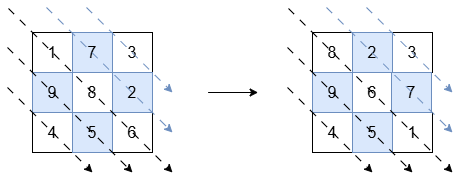
Input: grid = [[1,7,3],[9,8,2],[4,5,6]]
Output: [[8,2,3],[9,6,7],[4,5,1]]
Explanation:
The diagonals with a black arrow (bottom-left triangle) should be sorted in non-increasing order:
The diagonals with a blue arrow (top-right triangle) should be sorted in non-decreasing order:
Example 2
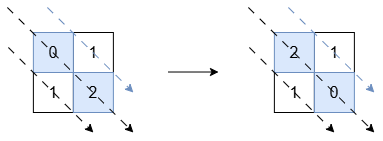
Input: grid = [[0,1],[1,2]]
Output: [[2,1],[1,0]]
Explanation:
The diagonals with a black arrow must be non-increasing, so [0, 2] is changed to [2, 0] . The other diagonals are already in the correct order.
Example 3
Input: grid = [[1]]
Output: [[1]]
Explanation:
Diagonals with exactly one element are already in order, so no changes are needed.
Constraints
grid.length == grid[i].length == n
1 <= n <= 10
-105 <= grid[i][j] <= 105
3446. Sort Matrix by Diagonals
Medium
30 Points
Array
Sorting
Matrix
You are given an n x n square matrix of integers grid. Return the matrix such that:
Examples
Example 1
Input: grid = [[1,7,3],[9,8,2],[4,5,6]]
Output: [[8,2,3],[9,6,7],[4,5,1]]
Explanation:
The diagonals with a black arrow (bottom-left triangle) should be sorted in non-increasing order:
The diagonals with a blue arrow (top-right triangle) should be sorted in non-decreasing order:
Example 2
Input: grid = [[0,1],[1,2]]
Output: [[2,1],[1,0]]
Explanation:
The diagonals with a black arrow must be non-increasing, so [0, 2] is changed to [2, 0] . The other diagonals are already in the correct order.
Example 3
Input: grid = [[1]]
Output: [[1]]
Explanation:
Diagonals with exactly one element are already in order, so no changes are needed.